A Year of Committed Zen Practice (P1) - Coming to the Practice
Each month, I spend at least one of my weekends away from home at a Zen center. I wake up to the sound of a bell, shuffle into a room with about 15 other people and complete 108 full body prostrations before spending the majority of the next 18 hours sitting completely motionless on a cushion facing the wall. Everything is conducted in silence. Meals are communal. Distractions, from phones to knitting to reading, are heavily discouraged. On longer retreats (anywhere between 2-7 days), my back, legs, knees, and hips are trading the lead position of Who Wants to Hurt More. Getting through a retreat always makes me feel a small sense of victory - “Thank god, I made it through.”
Unlike the qualities we tend to attribute to the word ‘Zen,’ retreats are, at least in my experience, deeply uncomfortable. Your body hurts, and the silence leaves you to face whatever situation arises without your typical comforts of talking away the unpleasantness or assuring that you haven’t upset or hurt someone. For example, I once made a soup for a retreat that was a little too spicy for most people’s tastes. As we ate in silence, I had to listen to an onslaught of sniffles, coughs, and exhalations, all the while not saying anything. I could not apologize or ask if it indeed too spicy. I simply had to watch people struggle through this meal, agonizing over the suffering I thought I had inflicted. It felt awful!
Nobody is forcing me to do this. In fact, I willingly give up time with friends, family, and occasionally my precious PTO to sit silently in a room. So why do this practice? What a wonderful question.
An introduction to the dharma.
The first time I attended a practice at my Zen center was in November of 2024 immediately following the results of the latest US presidential election. One of the knacks I’ve picked up from years of therapy is recognizing when I am going to need support, or at the very least when I anticipate the metaphorical shit is about to hit the fan. This was one such time.
In grad school (2022) I needed a one credit hour elective to amass the required credits needed to graduate. Instead of choosing something related to my degree, I instead was looking for whatever would be the “easiest” thing. Luckily, “Advanced Meditation” fit the bill. No synchronous classes and only lasting for half the semester, surely this would be a freebie!
That course changed my perspective towards how I interact with my mind and the world around me. Didn’t expect that! We had assigned readings by Jack Kornfield and Joseph Goldstein; the readings from Goldstein’s 'Mindfulness' in particular granted me some relief from the spiraling emotions I was dealing with immediately following Russia’s invasion of Ukraine. The following years I intermittently checked out Buddhist services in my area, hoping to continue building on what I’d been exposed to.
The Zen center is located in a college town just outside of the metro I live in, about a 40 minute drive away. It was founded in the late 70’s under the lineage of a Korean Zen Master, and is part of the largest school of Korean Zen in the United States (Kwan Um - “Perceive World Sound” - it’s part of the Kwan Um School of Zen). I had wrestled with the idea of Zen over the previous few months. The Zen center was actually last on my list of Buddhist services to check out - Vajrayana/Tibetan Buddhism was too complex for me, and the more general Western Buddhism (a loaded term in more ways than one) services I’d attended at the like Unity Temple didn’t provide the depth or challenging of perspective I think I needed at that time, though I did like the 15 minute meditation at the beginning of each service.
Upon walking into the Zen center, I was greeted by a man who had to be at least in his early 80’s wearing a long gray robe. My cult senses were tingling. He then showed me the practice forms - bowing, chanting. Cult senses were REALLY tingling at this point. I decided to stick it out through the remainder of the service and never come back.
When the service began, however, something clicked. The chanting was intuitive. The bows were simple and few in number (3). The seated meditation left me with a completely numb right leg. But what surprised me most was the dharma talk. I don’t want to brag, but I’m pretty good at intuiting the “correct” answer typical progressive spiritual settings. I, unfortunately, can out-talk most any therapist I’ve ever had, leading me to “graduate” therapy only to find I don’t actually believe a word I say. Or rather, I know what I say is correct, but it’s not something I feel, truly believe in my core. I expected more of the same here - feel-good, nebulous 'fluff' that anyone who'd spend enough time on Twitter in the late 2010's could intuit.
I felt utterly confused by everything that came out of the guiding teacher’s mouth. I would try and guess how she’d respond to a question and be totally, completely incorrect. “Don’t make right and wrong.” “When you have no mind, correct action will always appear.” “Situation, relationship, function.” “Zen is before words, before speech, before thinking.”
Huh?????
Everything clicks.
It was that not knowing, not understanding that hooked me. There was something here, something I did not understand. Or perhaps I already understood it, but just could not see it. A mirror that needed polishing. The incredibly direct nature of Zen appealed to me. Sit on a cushion. Set a timer. Stay on the cushion until the timer goes off. There is no successful or unsuccessful way to meditate. Watch things as they pop into your head and then bring your mind back to the present.
Though Zen has an initial learning curve (unlearning curve?) and an INCREDIBLE amount of nuance, nothing has ever made more sense to me, made sense in a way that I cannot articulate. I’ve never immediately clicked with a practice in such a way. Teachings are obvious, but only when you stop thinking. When you stop thinking, the teachings are very clear. Let me tell you, though, it’s hard to stop thinking!
This mindset is precise opposite of my experience in trying to live a happier, better life. Surely, there was information out there that could change my life. I needed to read more philosophy, or view the world through a particular lense, delve deep into some spiritual path. Zen disrupted that for me. AND - perhaps the most important ‘and’ here - is Zen does not ask you to compromise your worldview. It does not ask you to disregard science. Rather, it changes your perspective.
You can read one hundred books on trying to understand the taste of sugar, but the best way to experience sugar is to simply taste it.
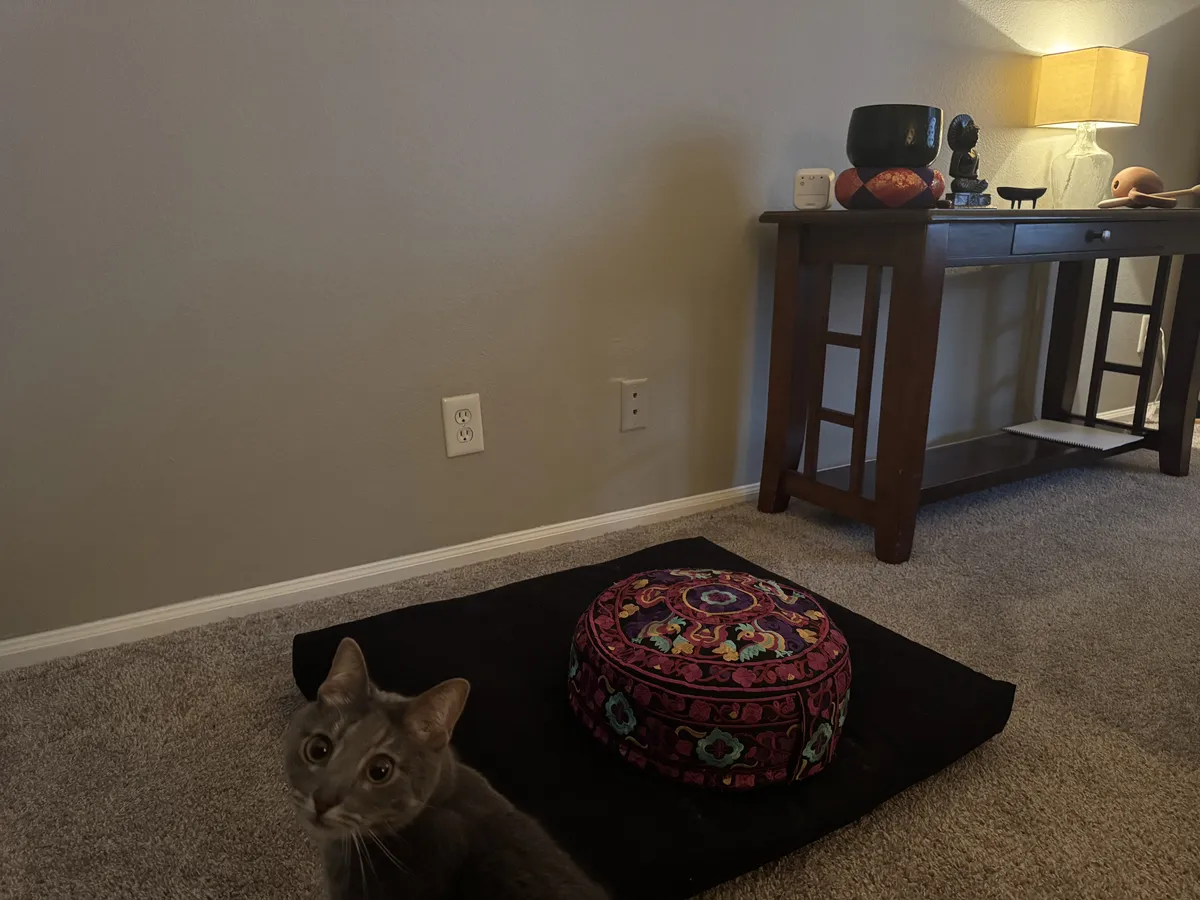
So now, I sit.